Posts

Property development consultants: why your project team matters to lenders


Written by

David Lovato, Founder and Director, CPC Lending Solutions

Construction and development finance specialist | Credit Representative CRN 542495 of QED Credit Services Pty Ltd (Australian Credit Licence 387856) | Member of Loan Market Group

Published October 2026

Property development consultants are the specialists who plan, cost, approve and deliver a project. A typical project needs eight: a development or project manager, a town planner, an architect, a quantity surveyor, engineers, a builder, a lawyer and a selling agent. That team matters for funding because a construction lender is lending against a building that does not exist yet. Construction again recorded more insolvencies than any other industry in 2025–26, so lenders now test two things closely: whether your team has delivered this type of project before, and whether its numbers hold up.

If you hold a site and have not yet applied for construction finance, this is the part of the application that gets the least preparation and the most scrutiny.

The consultants a lender expects to see

Here is the core team, when each is usually engaged, and what a lender looks for.

• Development or project manager. Engaged at site acquisition or before tender. A track record on projects of similar type and scale, and a realistic programme.

• Town planner. Engaged before design starts, ideally before you buy. Development consent, or a realistic path to it, with conditions the lender can price.

• Architect. Engaged at concept stage. A design that matches the consent and the feasibility, with a yield the market will buy.

• Quantity surveyor. Engaged at feasibility and again before tender. An independent cost plan, a cost to complete and a contingency that holds up.

• Engineers (structural, civil, services, geotechnical). Engaged during design development. No unpriced site risks such as soil conditions, contamination or service upgrades.

• Builder. Engaged at tender. A sound balance sheet, a current licence, experience at this size, a fixed-price contract and home warranty insurance where required.

• Lawyer. Engaged at acquisition and again for contracts and sales. Clean title, enforceable presale contracts and a builder’s side deed that lets the lender step in.

• Selling agent. Engaged before marketing. Arm’s-length presales at realistic prices, backed by real deposits.

Between them, the planner and architect decide what goes on the site, the quantity surveyor and engineers decide what it costs, and the agent tests what it will sell for. A margin that looks healthy on paper disappears if the cost plan is two years old or the end values came from the developer rather than the agent. If your feasibility predates the latest cost increases, our piece on project feasibility explains what to re-test.

Why lenders judge the team, not just the site

The biggest single risk in a construction loan is delivery. A lender will ask whether the team has built this type of project before: the same asset class, a similar number of dwellings, a similar build value.

That is where many first and second projects stall. A developer who has done a duplex and now wants twelve townhouses does not yet have delivery experience at that scale, however capable they are. Engaging an experienced project manager to run the tender and manage the build is the most direct way to borrow that experience, and it is often the difference between an indicative term sheet and a formal approval.

What a lender wants from your QS

Your quantity surveyor’s report is the document a lender reads most closely, because it shows whether the loan will be enough to finish the building. Expect the lender to want a cost plan that reconciles to the builder’s contract price, a clear contingency and a schedule of what is and is not included.

Most lenders also appoint their own QS to review your numbers and then certify each progress claim before funds are released. If the two reports disagree materially, the lender’s figure wins and the gap usually comes out of your equity. A QS whose reports lenders already rely on saves time at credit.

Builder insolvencies have raised the bar

In the 2025–26 financial year, 3,472 construction companies entered external administration or had a controller appointed, more than any other industry, according to ASIC’s insolvency statistics as reported by Accountants Daily. The same report noted that construction posted its strongest conditions in years in the latest NAB Business Survey. A busy market does not remove builder risk.

A builder collapsing mid-project is what turns a performing loan into a problem loan. Credit teams now look harder at the builder’s finances and pipeline, whether the price was won by underquoting, and whether your team could bring in a replacement builder if it came to that. Our guide to avoiding builders on the brink covers the warning signs.

How to choose your team

Choose for relevant experience first. Then check four things: recent comparable projects you can verify, professional indemnity insurance and licensing, whether lenders have relied on their reports before, and a fee structure that does not reward them for telling you what you want to hear. For the builder, our article on choosing the right builder goes further.

Assemble the team before you approach a lender, not after a lender has found the gaps. The same applies to the finance itself, as our recent piece on how structure decides who absorbs the loss explains.

Frequently asked questions

Do I need a development manager?

Not if you have delivered projects of a similar type and size. If you have not, appoint a development or project manager. It is the quickest way to show a lender delivery experience at this scale.

What does a quantity surveyor do for a lender?

The QS confirms the project can be built for the budget. The lender uses the cost plan to size the loan, then relies on monthly QS certification to release each drawdown against work completed on site.

When should I engage a town planner?

Before the architect starts design, and ideally before you buy the site. The achievable yield drives every other number in the feasibility.

Can a weak team stop my loan being approved?

Yes. A lender can decline, reduce the loan or add conditions when the team lacks relevant experience, the builder’s finances are weak or the QS report does not reconcile to the contract. Most of these gaps can be fixed before you apply.

Talk to CPC before you approach lenders

We see what credit teams ask before you do. If you hold a site and are preparing for construction finance, CPC can review your consultant team, cost plan and feasibility against what lenders will test, and show you where the gaps are while they are still easy to close.

Book a call with David Lovato →

Read the CPC Development Finance Guide →

General information only, not financial or credit advice. Lender requirements vary and are subject to each lender’s credit assessment.

When capital tightens, structure decides who absorbs the loss

When capital tightens, structure decides who absorbs the loss

Written by

David Lovato, Founder and Director, CPC Lending Solutions

Construction and development finance specialist | Licensed Credit Representative CRN 542282 | Member of Loan Market Group (LMG)

Published 17 September 2026

Development finance structure is the arrangement of senior debt, mezzanine debt and equity across a project, and the security, ranking and exit conditions attached to each layer. When funding is cheap and values are rising, a weak structure rarely shows. When rates rise and sale prices soften, structure decides who carries the loss.

Two things happened in the past month that put this in front of every Australian developer.

A market that is testing structures

In August, administrators were appointed to Universal Property Group and associated companies in the Bathla Group, a business ABC News reported had disclosed $3.2 billion in liabilities as at June 2025, funded across dozens of separate lending relationships. No finding has been made that the way the group structured its finance caused its difficulties, and none is suggested here. What the situation shows is how a highly leveraged business with many lenders behaves when sales slow, costs stay high and refinancing gets harder at once.

At the same time the cost of capital is moving. The US Federal Reserve lifted its target range to 3.75 to 4.00 per cent on 16 September, its first increase since July 2023, which feeds through to the wholesale markets Australian non-bank lenders fund themselves in. Domestically the cash rate has been at 4.35 per cent since May; the Board left it there in August while describing policy as “somewhat restrictive”, and another increase is widely anticipated at the 29 September meeting. Treat the direction as your planning assumption and the timing as unknown.

Where structure decides the outcome

Three things matter more than the headline rate.

Ranking. Senior debt is repaid first, mezzanine debt second, and equity last. The senior lender holds first-ranking security and can enforce, appoint a receiver and sell. Everyone behind it is a spectator to their own project.

Security. Cross-collateralisation means security for one facility can also secure another, and cross-default means a default on one facility can trigger one elsewhere. Both are common and neither is improper, but together they turn a contained problem into a portfolio-wide one.

Exit. Most development facilities are short and assume a defined repayment: presale settlements, a residual stock facility, a sale or a refinance. A structure that only works if the exit happens on schedule, at the forecast price, has a single point of failure.

Leverage is where it bites first

High leverage is not a problem until the sale price moves, and then it is the only problem.

Structures taking total gearing into the nineties as a percentage of end value have been readily available in this market, typically a stretched senior facility around 65 per cent of end value with preferred equity layered above it. On a rising market that works. At 94 per cent of end value, a single-digit movement in sale prices consumes the developer’s margin entirely and starts to reach toward the capital behind it. The junior lender feels it before the senior one does.

A lot of projects were funded at peak values on close to maximum gearing and are now settling into a softer market. Gearing to the limit a lender will allow is a decision about how much room you have if the valuation is wrong. It deserves to be made deliberately rather than by default. Sizing that buffer is one of the first conversations CPC has on any new file.

How CPC can help

Most structural problems are cheap to solve before a term sheet is signed. Almost none are solvable afterwards.

Set gearing you can survive — not just the maximum a lender allows.

Comparing structures rather than headline rates and setting gearing at a level the project can absorb is where CPC starts. The right answer depends on the site, the programme and the presale position. CPC arranges development finance and construction finance file by file, across bank, non-bank and private capital — each carries different pricing, security requirements and flexibility.

Match the right capital to your project — and know when not to layer it.

Mezzanine finance and preferred equity solve real problems, at a real cost in return and control. Our private lending guide explains how the non-bank channel is structured and when it is the better fit. Knowing when not to use layered capital matters as much as knowing how.

Plan the exit and close funding gaps before they become expensive.

Refinancing, residual stock and off-the-plan settlement facilities work best when arranged early, not when a facility is about to mature. CPC tests the funding requirement across the whole project rather than to the next drawdown, so a shortfall surfaces with time to deal with it.

Frequently asked questions

Does a rising cash rate change how a development loan is structured?

It changes the assumptions the structure depends on. Higher rates increase holding costs, tighten feasibility margins and can alter what a refinancing lender will advance at maturity. The structural response is usually a longer term, a more realistic extension mechanism and more contingency built into the programme — rather than a different headline rate.

How much gearing is too much?

There is no single figure, but the practical test is whether the project survives a three-month delay and a five per cent movement in sale prices without needing new capital at short notice. If it does not, the gearing is too high for the risk being carried.

What should a developer check in a term sheet before accepting it?

What the security covers and whether it extends to other projects. Whether cross-default provisions exist. How an extension is triggered and priced. What the lender can require if a valuation moves. What the facility assumes about the exit. Each is negotiable before signing and fixed afterwards.

Talk to CPC before the term sheet arrives

If you have a development project at any stage — feasibility, site acquisition, construction or refinancing — CPC can review the proposed structure and test it against the funding requirement across the whole programme.

Book a call with David Lovato → 

Download the CPC Private Lending Guide →

When presales fall short, a residual stock loan could be the answer


Written by David Lovato – CPC Development Lending Solutions

June 2026

Many developers started projects in 2025 expecting sales to catch up during construction. Instead, some are approaching completion with fewer presales than anticipated and a construction loan that still needs to be repaid. 

If this sounds familiar, a residual stock loan could be an option for you. 

Why have presales slowed?

The off-the-plan market is under pressure from several directions at once. The Reserve Bank of Australia (RBA) has raised the cash rate three times in 2026, taking it to 4.35%, undoing all three of the cuts delivered in 2025. Reduced borrowing capacity means fewer buyers can qualify for finance at the prices developers need to achieve, shrinking the pool of potential purchasers considerably.  

Buyer sentiment has been affected by uncertainty around interest rates, the cost of living and the Federal Budget’s negative gearing and capital gains tax (CGT) changes. While the reforms aren’t yet official – and even if they do become so, they won’t take effect until 1 July 2027 – some prospective investors are taking a cautious approach while they assess the implications for their own position. According to the latest Westpac-Melbourne Institute Consumer Sentiment Index, the “time to buy a dwelling” index dropped 13% in June 2026 compared to the same time in 2025. 

Longer build timeframes add another layer of hesitancy. A new report from the Committee for Economic Development of Australia (CEDA), produced in partnership with Urbis, found that build times have increased by 40% since the pandemic, and construction costs have surged by 88% over the last 10 years. As a result, buyers who commit to off-the-plan are locking in a purchase price for a property they may not settle for a year or more, in a market where the outlook has become harder to read. 

There is also a dynamic specific to developers themselves. Many could generate more sales by discounting, but doing so risks resetting the price benchmark for the entire project. Some are consciously choosing to protect value rather than chase volume – a sound strategy, but one that slows sales in the short term. The result for projects completing right now is fewer locked-in sales than anticipated and, in some cases, presale numbers that fall short of what is needed to repay the construction lender. 

What is a residual stock loan? 

A residual stock loan is designed specifically for this situation. It allows a developer to refinance out of their construction loan at or near practical completion, replacing it with a new facility secured against the unsold dwellings. 

Rather than being forced to discount to generate quick sales and meet a construction loan maturity date, the developer transitions to a lender whose facility is structured around a sell-down period. This gives your sales team time to properly nurture qualified buyers through the decision-making process, hold prices at the levels the project’s feasibility requires and avoid the pressure to discount that comes when a construction loan maturity is bearing down.  

The key benefits of a residual stock loan 

The most immediate benefit is time. A residual stock facility extends your timeline, removing the pressure of a looming construction loan maturity while your sales campaign is still gaining traction. 

It can also reduce holding costs. Residual stock facilities are typically structured differently from construction loans, and refinancing at the right time can lower the cost of carrying unsold stock through to settlement. 

There is also the potential for early equity release. Some residual stock lenders will agree to a split of sale proceeds as individual settlements occur, meaning you can begin recovering equity from completed sales rather than waiting until the entire facility is repaid. For developers with capital committed across multiple projects, this can help with cash flow. 

What to consider before choosing a residual stock loan

Residual stock facilities are not without trade-offs. Interest rates are typically lower than a construction loan as there is no line fee or progressive drawdown, so there is less ongoing admin for the lenders. The loan will have a fixed repayment date but no minimum term, so you don’t get penalised if you repay the loan early.

Lenders will also assess the quality and location of the unsold stock, the strength of the sales pipeline and, often, the experience of the appointed sales agent before agreeing to terms. A project with limited buyer interest or in a softening market may find residual stock options harder to access, or available only on less favourable terms. 

It is also worth noting that a residual stock loan is a bridge, not a solution in itself. If the underlying demand for the project is genuinely weak, extending the sell-down period will delay rather than resolve the problem. The facility works well when the issue is timing and market conditions, not fundamental project viability. 

Timing matters

Many developers wait until practical completion to investigate residual stock finance, but by then, your options could be more limited. As soon as it becomes clear that sales are tracking below expectations, you should consider engaging a specialised development finance broker about your options. 

Starting the conversation early gives you more flexibility, more lender options and more time to structure an orderly transition out of the construction facility if required. 

At CPC Lending Solutions, we help developers assess residual stock options before settlement pressure builds, giving you more time to achieve the right sales outcomes rather than being forced into decisions by looming loan deadlines. To find out more about how CPC approaches development finance, download the CPC Lending Solutions Development Lending Guide. 

If you would like to discuss your specific situation, contact David Lovato at dlovato@crowdpropertycapital.com.au or submit an enquiry.

How the Federal Budget reshapes development finance


Written by David Lovato – CPC Development Lending Solutions

May 2026

The 2026-27 Federal Budget has fundamentally shifted the landscape for property development finance in Australia. And when you combine what was outlined in the Budget with APRA’s proposed capital reforms announced in March, the picture that emerges could be one of the most significant resets in development lending conditions in years. 

New builds win under the new tax rules 

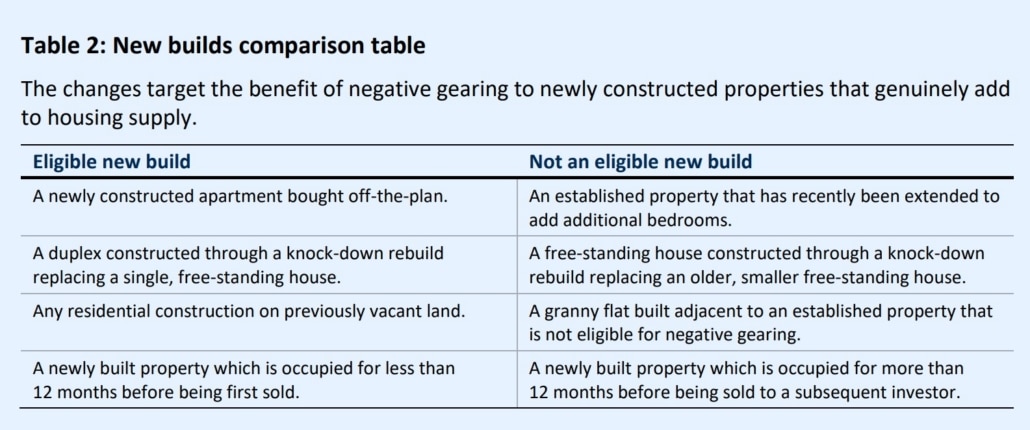
The centrepiece housing tax reform in the Budget is the restriction of negative gearing to new residential properties from 1 July 2027, combined with a major overhaul of the capital gains tax (CGT) discount. 

From July 2027, investors who buy established properties will lose access to negative gearing against their wages and other income. And the 50% CGT discount will be replaced with an inflation-indexed system with a 30% minimum tax. 

New builds are explicitly exempt. Investors who buy newly constructed dwellings will retain full negative gearing and can choose between the existing 50% CGT discount or the new indexation system when they sell. 

Practically, this means that from 1 July 2027, the established property market and the new build market will operate under two entirely different tax regimes, and new builds win on almost every measure. 

Treasury modelling estimates the reforms will support around 75,000 additional owner-occupiers over the next decade. But the less-discussed consequence is the wave of investor demand that will shift towards newly constructed dwellings. 

For property developers, this could be the start of a new wave of demand. 

APRA could remove the final barrier 

Here is where it gets interesting for development finance specifically: Banks make money on long-term residential investment loans. If investor demand is shifting structurally towards new builds, banks have a strong commercial incentive to fund the short-term development loans that produce the stock those investors will buy. One feeds the other. 

But there is a problem. Under existing capital rules, development loans attract some of the highest reserve requirements of any loan type, making them expensive for banks to hold and, for many lenders, not worth the trouble. This is precisely why banks have been retreating from development lending for years, leaving developers increasingly reliant on non-bank lenders at higher rates. 

In March, Australia’s banking regulator, APRA, proposed reforms that directly address this. The regulator has proposed adjusting the capital rules for land acquisition, development and construction loans, allowing well-credentialed projects to qualify for lower reserve requirements. The explicit goal is to give banks more capacity and more commercial incentive to lend to residential developers. 

Put it together and the picture is clear. The Budget has created a structural demand shift towards new residential supply. APRA has proposed rules that make it cheaper for banks to fund that supply. And for the major banks, there is an additional commercial reality at play: as investor demand moves away from established stock, the long-term residential investment loans that banks rely on will increasingly be tied to new builds. To maintain that loan book, banks need new supply, which means funding the short-term development loans that produce it. 

It is, in effect, a double incentive. 

And as a result, development lending is about to look considerably more attractive to the major banks than it has in years. 

What this means for developers right now 

There are some timing considerations. APRA’s reforms are still proposals. Consultation is underway and implementation will be phased. The Budget changes don’t take effect until 1 July 2027, so the market will take time to adjust. 

But the developers who move early – who get projects into the ground, through the approvals process and ready to sell into a market where new builds carry a significant tax advantage over established stock – could be well-positioned to benefit. 

That means getting your finance strategy right now, not in 2027. 

At CPC Lending Solutions, we work closely with developers to match projects to the right lenders at the right time. The lending landscape is shifting, and knowing which lenders are already moving to increase their development appetite is knowledge that can help you secure the right finance. 

To find out more about how CPC approaches development finance, read our CPC Lending Solutions Development Lending Guide. To discuss your next project, contact us at dlovato@crowdpropertycapital.com.au or submit an enquiry.

The Middle East oil crisis is adding a new layer of risk for developers – here’s how to prepare


Written by David Lovato – CPC Development Lending Solutions

April 2026

Australian property developers were already navigating one of the toughest feasibility environments in years before the Middle East crisis escalated. Construction costs were elevated, inflation was sticky and interest rates had moved higher. Now, a global oil shock is adding a new and unpredictable layer of risk – one that developers need to factor into their planning right now.

What the crisis means for construction costs

With global oil supplies disrupted, the most direct impact is on diesel, and for property developers, diesel is everywhere. When diesel prices rise sharply, the cost of almost everything on a construction site moves with it. Diesel hit $3 per litre in March 2026, and the flow-on effects for construction budgets are already being felt.

A significant share of construction materials – structural steel, timber, concrete products, bricks, PVC and plastics – travels considerable distances before it reaches a development site. When fuel costs spike, freight costs follow. The Housing Industry Association (HIA) noted that construction costs have already risen 40% since 2019, and warned that the Middle East conflict is now generating real, immediate fuel and materials cost increases that builders under fixed-price contracts cannot pass on to clients. 

It is not just fuel prices driving this. The conflict has forced shipping to be rerouted away from the Persian Gul and war-risk insurance premiums have surged. Several major insurers have cancelled Gulf coverage entirely. These are real cost increases that flow through supply chains over weeks and months, meaning developers who are mid-project or about to commence may not have fully felt the impact yet.

Fixed prices are also a challenge

The HIA has also highlighted a structural risk specific to the way Australian construction works. Residential builders commonly sign fixed-price contracts well before construction begins, sometimes months in advance. Once a contract is signed, the price is locked in. Builders then have to navigate whatever changes occur between signing the contract and completing the home.

For developers, this is a critical reminder: your builder’s exposure to sudden cost movements can quickly become your problem, through delays, stalled projects or renegotiation pressure.

The rate risk

Higher oil prices are feeding directly into inflation. The Reserve Bank of Australia (RBA) raised the cash rate to 4.10% at its March 2026 meeting – the second consecutive increase – driven by persistent inflation, with the February consumer price index showing annual inflation at 3.7%, still well above the RBA’s 2–3% target band. And critically, that February data predates the worst of the fuel price spike, meaning further pressure is likely still to come through.

For developers, this creates even tighter conditions. Higher rates increase your borrowing costs on land and construction facilities, while also reducing buyer borrowing capacity – which can soften pre-sale demand and dampen the end values your feasibility depends on.

A ceasefire has since been called, which may ease some of the immediate pressure on oil prices and shipping routes. However, the situation remains fragile and the economic damage already done will take time to work through the system. Construction material costs, freight surcharges and insurance premiums do not normalise overnight, and with the RBA already having moved twice, the interest rate environment is unlikely to soften quickly even if the conflict de-escalates further.

What developers should be doing now

None of this makes development impossible. Australia’s structural housing shortage hasn’t gone away, and demand for well-located, appropriately priced projects remains solid. But it does make preparation and discipline more important than ever.

Here are a few practical steps worth considering:

  1. Revisit your cost plan. If your feasibility was prepared before the oil crisis escalated, it may need refreshing. Build in a buffer for transport cost increases and material surcharges, even if your builder hasn’t flagged them yet.
  2. Stress-test your finance against a higher-rate scenario. The RBA has now raised rates twice in consecutive meetings. If rates move again, can your project still stack up? Know your break-even point before your lender asks.
  3. Move on finance sooner rather than later. Lender appetite and terms can shift quickly in volatile conditions. Getting your funding locked in before the situation develops further removes one significant variable from an already uncertain picture.
  4. Talk to a specialist broker. In the current climate, not all lenders are responding the same way. Some are tightening criteria, while others are actively looking for well-structured deals. Knowing which lenders have appetite for your project type and location right now is genuinely valuable intelligence.

If you want to understand how CPC approaches development finance, our CPC Lending Solutions Development Lending Guide is a good place to start. 

If you are planning a project and want to understand how the current environment affects your funding options, contact CPC at info@crowdpropertycapital.com.au or submit an enquiry to discuss how we can help structure the right finance solution for your project.

The co-living pipeline is growing fast – is it right for your next project?


Written by David Lovato – CPC Development Lending Solutions

March 2026

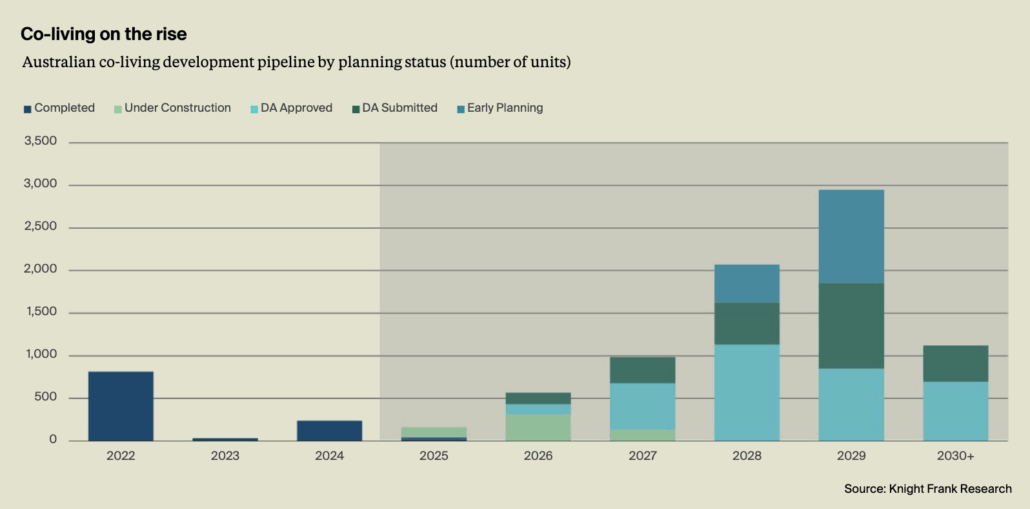
Australia’s co-living sector is expanding rapidly as developers search for feasible ways to deliver new housing in a challenging development environment. Rising construction costs, tighter feasibility thresholds and higher funding costs have slowed many traditional residential projects. In contrast, co-living developments have continued to gain traction.

Co-living refers to a housing model where residents rent private, self-contained studios while sharing communal amenities such as kitchens, lounges or workspaces. The format has emerged as a distinct asset class within Australia’s living sector and is already seeing steady expansion, particularly in Sydney.

Several structural advantages explain why the model is attracting developer attention. Smaller scheme sizes, lower land requirements and higher rental income per square metre can allow projects to meet feasibility thresholds where larger developments may struggle.

A sector moving beyond the early stage

Although still relatively new in Australia, the sector is beginning to scale. Approximately 4,159 units are already under construction or approved, with another 3,647 units proposed.

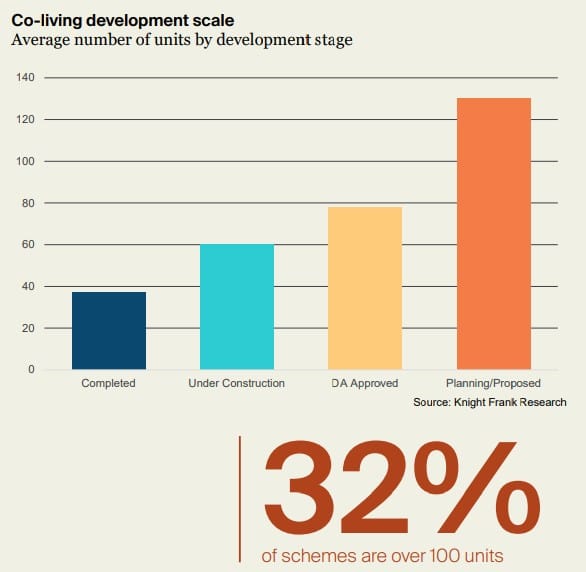
Project scale is increasing as the market matures. The average co-living development currently contains about 37 units, rising to around 60 units for schemes under construction and 78 units for projects with development approval. Proposed developments are averaging about 130 units.

Demand drivers supporting the model

Strong tenant demand, particularly from young professionals seeking affordability and flexibility, is underpinning this growth. Around 90% of co-living tenants are aged between 20 and 40, with the 20–30 age bracket alone accounting for 72% of residents.

Flexibility is another key attraction. Lease terms can begin from three months, compared with the traditional six or twelve-month leases that dominate the standard rental market.

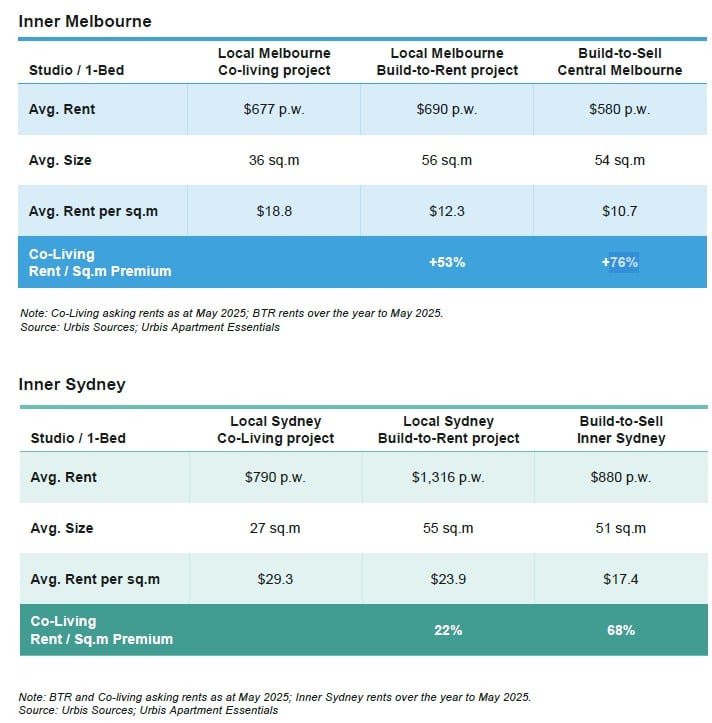
Affordability remains a significant factor. Rents for completed co-living developments in inner Sydney start at about $675 per week, including utilities and furnishings. By comparison, a privately leased apartment averages around $730 per week before utilities and furnishings, which can increase total costs to roughly $880 per week. 

The model delivers strong revenue efficiency for developers. Co-living projects can generate rental income premiums of between 22% and 76% per square metre compared with other residential typologies.

Policy support and future growth

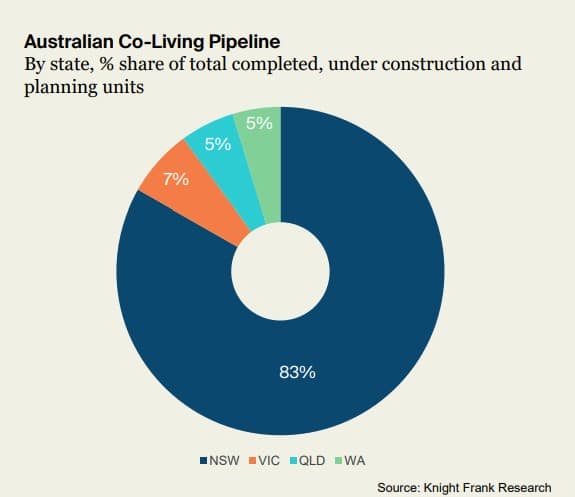
Planning settings have played a major role in enabling the sector. New South Wales has introduced a State Environmental Planning Policy specifically recognising co-living developments, creating a clearer pathway for approvals. This has helped Sydney become the national centre of co-living development, hosting more than 90% of completed projects across Australia.

As other states develop clearer planning frameworks, development activity is expected to spread more broadly across the country. Institutional investors are beginning to explore the sector as part of broader living-sector strategies, following the growth trajectory previously seen in purpose-built student accommodation and build-to-rent assets.

Key considerations before pursuing a co-living project

While the model presents opportunities, successful projects require careful planning. Developers considering co-living should assess several factors early in the feasibility process:

  • Local planning frameworks and zoning rules
  • Site suitability and density potential
  • Target tenant demographics and location demand
  • Operational management and community programming
  • Financing structures aligned with rental income models

Projects located in dense urban areas with strong transport connections and employment hubs tend to perform best.

As the co-living sector expands, developers are increasingly assessing how emerging housing models can be structured and financed effectively. CPC Lending Solutions specialises in structuring development finance for residential and mixed-use projects across Australia. Our team works closely with established non-bank lenders that have demonstrated experience funding property developments through multiple market cycles.

You can read more about how CPC approaches development finance in our CPC Lending Solution’s Development Lending Guide.

If you are exploring a co-living project or assessing the feasibility of your next development, contact CPC at info@crowdpropertycapital.com.au or submit an enquiry to discuss how we can help structure the right finance solution for your project.


How construction costs and inflation are reshaping project feasibility


Written by David Lovato – CPC Development Lending Solutions

February 2026

For small and mid-sized developers, project feasibility has always been a balancing act between costs, end values and funding. In 2026, that balance is becoming harder to maintain. 

High construction costs and rising inflation are now front and centre in feasibility assessments, and in many cases are the difference between a project proceeding or being shelved.

Construction costs are still rising

Recent data showed construction cost growth is no longer surging at the pace seen during the post-COVID boom, but it is still rising. Cotality’s Cordell Construction Cost Index recorded a 1.0% increase in the December 2025 quarter, the strongest quarterly growth of the year.

The annual growth rate of 2.5% was significantly below the extreme peaks of recent years and the pre-COVID decade average of 4.7%. But for developers working on tight margins, any upward movement matters.

Structural timber and cement products recorded price rises after remaining stable for much of 2025, while wage increases following the Fair Work minimum wage update are adding to labour costs. Skilled trade shortages and supply chain adjustments are expected to remain challenges through 2026.

This uncertainty makes accurate cost forecasting – already tricky – even more difficult.

Inflation and interest rates

Inflation is also proving persistent. The Reserve Bank of Australia’s (RBA’s) preferred trimmed mean measure reached 3.3% year-on-year to December, up from 3.2% the month before, according to the Australian Bureau of Statistics. This was outside the RBA’s 2-3% target band. 

Housing-related costs – including rents and new dwelling construction – remained key contributors.

In response to this inflation news, the RBA lifted the cash rate to 3.85% at its first meeting of 2026. Even if further increases are limited, the move reinforces a “higher for longer” rate environment.

For developers, this creates a double squeeze. Higher rates increase your borrowing costs for land and construction, while also reducing buyer borrowing capacity, which can discourage buyers from entering the market. A slowdown in demand can dampen price growth, meaning end values for completed projects may not rise as robustly as developers had hoped when factoring in rising input costs. 

The feasibility challenge

This dual pressure creates a significant challenge. Without end value increases to offset rising construction costs, many projects won’t stack up anymore. Developers are finding that deals that may have looked viable six months ago no longer meet required return thresholds.

Feasibility buffers can be quickly eroded. A modest build cost variation, slower pre-sales or a few extra months on the schedule can significantly reduce margins. With thinner margins, the tolerance for error is lower than it has been in years.

Opportunities still exist, but discipline is key

None of this means development opportunities have disappeared. Australia continues to face a structural housing shortage, listings remain below trend and supply constraints persist. There is still strong demand for well-located, appropriately priced projects, particularly in affordable segments and growth corridors.

Government initiatives are also helping support feasible projects. Programs such as New South Wales’ Pre-sale Finance Guarantee can reduce risk for lenders and improve funding access for qualifying developments, while federal tax incentives for Build to Rent projects can boost after-tax returns and improve overall project viability for eligible developers.

However, feasibility studies now need to be more conservative and detailed. Lenders are increasingly stress-testing projects against higher rates, and you need to factor in cost escalation and slower price growth. Realistic timelines, detailed cost plans and careful revenue assumptions are becoming essential.

Finance strategy matters more than ever

In this environment, finance structure plays a larger role in the success of your project. Loan terms, lender appetite, pre-sale requirements and flexibility can all influence project outcomes.

Working with a specialist development finance broker can make a real difference. At CPC Lending Solution, we understand how different lenders assess risk, feasibility and locations, and can match projects to lenders with the right appetite.

We can also help package your finance application to clearly present your contingencies, margins and cost controls – all areas lenders are scrutinising more closely in the current climate.

You can read more about how CPC approaches development finance in our CPC Lending Solution’s Development Lending Guide.

CPC Lending Solutions helps developers structure finance that reflects today’s cost pressures and feasibility realities. If you’re planning a residential or mixed-use project, contact CPC at info@crowdpropertycapital.com.au or submit an enquiry to structure your finance with confidence.

Interest rate uncertainty hits developers


Written by David Lovato – CPC Development Lending Solutions

January 2026

Australia’s interest rate outlook has taken a turn, with economists now split on whether the Reserve Bank of Australia (RBA) will cut, hold or increase the cash rate in 2026. This uncertainty represents a significant shift from just 12 months ago, when the consensus accurately predicted rate cuts throughout 2025.

For developers, this adds fresh cost pressures to already tight project feasibilities. 

While the market saw three interest rate cuts in 2025, bringing the official cash rate to 3.60%, the pivot many developers hoped for has hit a roadblock. Recent economic data and expert forecasts suggest that instead of further relief, the industry must now brace for a “higher-for-longer” interest rate environment – and potentially even a return to tightening.

According to The Australian Financial Review’s latest quarterly survey of 38 major economists, 17 now expect at least two rate increases over the next 18 months. Seven economists, including those from the Commonwealth Bank and NAB, predict the RBA could hike as early as February’s policy meeting. 

What’s causing the uncertainty?

The catalyst for this hawkish shift is stubbornly persistent inflation. After annual trimmed mean inflation (the RBA’s preferred measure) unexpectedly jumped to 3.3% in October, the RBA flagged that rate increases remained on the table. 

The latest November inflation data offered modest relief, according to the Australian Bureau of Statistics, with trimmed mean inflation declining from 3.3 to 3.2%, although still well above the central bank’s 2-3% target band.

What does this mean for developers?

This potentially higher-for-longer rate environment creates intense pressure on project feasibility. Every increase in borrowing costs directly impacts development margins, turning previously viable projects marginal or even unviable. 

Additionally, construction costs have remained elevated and are expected to rise further in 2026, with project advisory firm WT predicting a 5.2% increase. 

When interest rates remain elevated alongside rising material and labour costs, the margin for error disappears. As a result, lenders can become more cautious. CBRE’s lender sentiment survey for the second half of 2025 found that elevated construction costs were the biggest challenge facing Australia’s lending environment. 

Choosing the right lender

Despite the pressure, opportunities remain for developers who can present financially robust, well-located projects. Those that can factor in realistic contingencies for labour, material costs and interest rate fluctuations are well placed to secure funding and deliver on time. 

However, even with this preparation, choosing the right lender has never been more important. Generic, one-size-fits-all lending approaches simply don’t work when margins are tight and market conditions vary significantly across locations and projects. Developers need lenders who genuinely understand the specific markets they’re operating in – lenders with in-house expertise to properly assess the fundamentals of good projects in strong locations.

But how do you, the developer, identify an appropriate lender? That’s where a specialist broker comes in, connecting you with lenders who have the in-house expertise to properly assess the fundamentals of good projects in strong locations. 

Smaller developers, in particular, can benefit from the expertise of specialist brokers like CPC, who will align projects with lenders that understand your market perspective and project feasiblity.

Beyond connecting developers with lenders who understand market conditions, CPC know how to structure and package loan applications to highlight project feasibility, margins and risk management – increasing the likelihood of approval and keeping developments viable despite elevated borrowing costs.

You can read more about how CPC approaches development finance in our CPC Lending Solution’s Development Lending Guide.

CPC Lending Solutions helps developers navigate funding in a higher-for-longer rate environment. If you’re planning a residential or mixed-use project, contact CPC at info@crowdpropertycapital.com.au or submit an enquiry to structure your finance with confidence.

NSW expands its Housing Pattern Book to include mid-rise apartments


Written by David Lovato – CPC Development Lending Solutions

December 2025


The NSW Government has released the next major stage of its Housing Pattern Book: a collection of nine architect-designed mid-rise apartment patterns aimed at speeding up approvals and lowering upfront costs for developers. The new designs – ranging from three to six storeys – build on the eight low-rise “missing middle” patterns released earlier in 2025.

For developers, builders and mum-and-dad investors, the move to standardised mid-rise designs points to a clearer, more predictable pathway for medium-density projects. By reducing design uncertainty and simplifying early assessment, it has the potential to shorten timelines and lower holding risks, which in turn shapes how development finance is structured and assessed.

A broader range of ready-to-build designs

The mid-rise release includes:

  • Four patterns for small lots
  • Three patterns for large lots
  • Two corner-lot designs

All have been produced by leading architectural practices across Australia and New Zealand. The designs are contemporary, energy-efficient and meet the Australian Building Codes Board’s Liveable Housing Design Standard. With options for solar access, cross-ventilation, adaptable layouts and various material palettes, the patterns maintain architectural quality while being practical to build at scale.

Faster, simpler approvals for mid-rise projects

Unlike the low-rise patterns, which can use a complying development certificate (CDC), the mid-rise designs still require a development application. But the government has implemented important measures to streamline the process.

Because the designs are pre-endorsed by the NSW Government Architect, councils have been instructed to:

  • Remove design review panel requirements
  • Halve average assessment times
  • Assess patterns under officer delegation, avoiding Local Planning Panel delays

In early 2026, new planning laws will introduce an even faster “targeted assessment pathway” specifically prioritising mid-rise pattern book designs.

For developers, this could provide more certainty. The hope is that timeframes become clearer, risk around design modifications is reduced, and feasibility modelling becomes easier to forecast.

Lower upfront design costs – with limits

The pricing for the patterns is heavily subsidised for the first six months:

  • Small and corner lot designs: $1,500 per lot (normally $15,000)
  • Large lot designs: $2,500 per lot (normally $25,000)

While not as cheap as the introductory $1 pricing for the original low-rise patterns (available until January 2026), these fees are still far below the cost of bespoke architectural design. For developers handling multiple lots, the savings can be meaningful.

However, as with the low-rise patterns, these plans are not turnkey solutions. Developers will still need:

  • Site-specific engineering
  • Planning documentation
  • A registered architect (required for all mid-rise projects)
  • Quantity surveying
  • Construction certificates
  • Adjustments for site slope, bushfire, soil or flood conditions

The patterns reduce design complexity and approval risk, but they do not eliminate the need for full due diligence.

What the expanded Pattern Book means for development finance

For lenders, the mid-rise patterns help address one of the biggest barriers to financing small-to-medium residential developments: uncertainty.

Standardised, pre-endorsed designs will make it easier for a lender to assess:

  • Buildability and construction risk
  • Likely build costs (within a tighter band)
  • Approval timelines
  • End valuations, thanks to clearer comparables

With less ambiguity, developers – particularly small builders or first-time apartment developers – can present a stronger feasibility and secure funding with fewer unknowns. Faster approvals may also reduce holding costs, improving project viability.

However, lenders will still closely assess contingency allowances, builder experience, equity position, presales (where required) and cost escalation risks.

Why developers still need a specialist broker like CPC

The pattern book removes friction, but it does not guarantee funding. Even with streamlined designs and faster approvals, development finance remains complex. Lenders interpret the pattern book differently, credit appetites shift frequently, and individual project variables still influence borrowing capacity, structure and pricing.

A specialist broker like CPC Lending Solutions understands how lenders are assessing pattern book projects right now, which lenders are backing mid-rise schemes and what parameters developers must meet to secure competitive terms. We can help structure funding that aligns with realistic timelines, cash flow needs and lender expectations – ensuring that the benefits of the pattern book actually translate into a deliverable, financeable project.

Before you begin planning finance for your next mid-rise development, you can also download CPC Lending Solution’s Development Lending Guide for a clear breakdown of lending criteria, funding structures and market insights.

Headline image: Small Lot Apartment 04 by Neeson Murcutt Neille, one of the nine approved designs. Credit: planning.nsw.gov.au

CPC Lending Solutions helps developers secure finance for projects using the NSW Housing Pattern Book. If you’re planning a mid-rise or missing-middle development, contact CPC at info@crowdpropertycapital.com.au or submit an enquiry to structure your funding with confidence.

How to position your next project for NSW’s Pre-Sale Finance Guarantee


Written by David Lovato – CPC Development Lending Solutions

November 2025


The New South Wales government’s $1 billion Pre-Sale Finance Guarantee scheme aims to unlock stalled housing projects by helping developers secure construction funding sooner. It is a major shift designed to tackle one of the biggest challenges facing small- and mid-sized developers: meeting strict pre-sales thresholds set by lenders. 

But, not every project, or every developer, will qualify. And while the guarantee removes a key barrier, it doesn’t replace the need for sound feasibility, credible delivery partners and up-to-date documentation. 

Understanding how to position your application from day one could mean the difference between unlocking finance in months or watching competitors secure the limited pool of guarantees first.

How it works

Under the $1 billion Pre-Sale Finance Guarantee, the NSW government will guarantee up to 50% of eligible off-the-plan dwellings in approved residential projects of $5 million to $50 million, where the dwelling value doesn’t exceed $2 million per dwelling.

Projects of this size usually require 60-80% pre-sales for lenders to consider finance. By underwriting up to 50% of your dwellings, the government effectively halves your sales risk, allowing you to commence construction with a lower private sales threshold.

Projects must begin construction within six months of approval, and developers will pay a line fee – similar to loan interest – for the duration of the government’s guarantee.

If guaranteed homes remain unsold by completion, the developer can call on the government to purchase them at a reduced price. This discount should be at least 10% of the independently assessed market value.

Who can benefit from the scheme?

The scheme is aimed at shovel-ready, mid-scale residential projects that already hold planning approval. It’s not for speculative or early-concept developments. 

Based on the $5-50 million range for project size and the $2 million cap per dwelling, this will likely be between 10 and 100 units. This helps ensure the scheme targets attainable housing rather than luxury stock.

Developers who will benefit are likely to be those with robust track records, credible delivery teams and projects that demonstrate genuine market demand. 

However, the scheme could also benefit smaller or newer developers who might not have the financial track record of a larger business. If you have secured a quality site, sound feasiblity and a high-quality construction team, the guarantee offers the chance to use the state’s backing to gain lender confidence.

What will lenders and the government assess?

To qualify for the Pre-Sale Finance Guarantee, projects must meet both lender and government requirements. While there’s some overlap, each party has its own focus:

  • Feasibility and project merit: Realistic construction timelines, adequate contingencies and alignment with housing-supply priorities.
  • Developer capability and credibility: Financial stability, track record, governance, fixed-price contracts and experienced consultants.
  • Creditworthiness and security: Ability to service debt, pre-sales achieved, land value, developer contribution and a clear exit strategy.
  • Genuine need: The government, in particular, will assess that finance was otherwise unavailable or delayed due to unmet pre-sale targets.
  • Timing: A government requirement is that construction must begin within six months of approval.
  • Value protection: To meet the state’s requirements, dwellings are independently valued, with the state’s purchase commitment at a minimum 10% discount to market value.

Together, these assessments ensure projects supported under the scheme are both commercially viable and aligned with NSW’s housing priorities.

Mistakes you can’t afford to make

With the scheme now open for expressions of interest, developers need to be strategic from day one or risk missing out entirely. Common mistakes include:

1. Not engaging a specialised broker soon enough

Once you have secured NSW planning and development approval, contact a broker like CPC Lending Solutions right away. As the process for securing a guarantee will involve both your application to government as well as a lender’s application, leaving finance structuring or eligibility assessment too late can limit lender options and delay your application.

2. Miscalculating feasibility

Developers occasionally forget to include certain expenses when calculating their project’s feasibility. This can include loan application and establishment fees.

Under the government’s guarantee scheme, there will also be an ongoing annual line fee that should also be included in your overall expenses to model your project’s profitability accurately.

Similarly, the 10% minimum discount on government-purchased dwellings must be factored into your feasibility from the outset. Projects with tight margins will struggle to absorb this risk. To accurately predict even the worst-case scenario, run a test where all 50% of units guaranteed by government sell at the discounted rate and ensure your project still delivers acceptable returns. 

3. Ignoring the remainder of the pre-sale requirements 

The guarantee covers up to 50% of dwellings, but you still need a credible strategy to achieve genuine pre-sales for the remainder. Projects in weak markets or with poor sales fundamentals won’t suddenly become viable just because half the risk is underwritten. Projects where the non-guaranteed portion appears unlikely to sell will likely not be accepted by government, or by a lender.

For developers looking for a detailed roadmap, CPC Lending Solutions has compiled a comprehensive Development Lending Guide, providing the latest insights on structuring finance, eligibility and accessing government-backed schemes. You can download the guide here.

Ready to turn your approved project into a funded, government-guaranteed reality? 

CPC Lending Solutions specialises in guiding developers through every step, from assessing eligibility and structuring finance to preparing your application and negotiating with lenders. Get in touch today at info@crowdpropertycapital.com.au or fill in this form to discuss your next development and see how CPC can help you access the guarantee with confidence.